

Online Marketing Glossary: Analytics
Analytics:
- Technology that helps to analyze the performance of a website or online marketing campaign.
 Analytic data, while annoying for those of us that aren’t numbers people, are crucial to understanding where your visitors are coming from and what they want. It’s also imperative to know what you’re doing on your site is working and what needs to be changed. There are several free analytic tools out there, like SiteMeter, Google Analytics, and StatCounter.
____
Glossary Definition From ABC’s of Online Marketing by Alexandra Wharton, Issue 22, Revenue Magazine
Social Media Marketing Summit: Keynote 2 Shel Israel
I’m going to attempt to post this RIGHT after it’s done, so as I’m typing Shel Israel is talking. Don’t worry about not being rude. I have an uncanny knack of being able to type without looking at the screen. Nifty, huh? I digress, this presentation was given by:
- Shel Israel, writer, GlobalNeighbourhoods.net
 Shel took most of the presentation to talk about people he’d interviewed. Some of the anecdotes were useful and some were just that – anecdotes. I only outlined some of the more interesting ones for you that might have some take-home value.
Bullet Point Review!
- Has been following social media since 2005, taking a business look at human stories.
- He gets paid to interview people about social media & how it impacts their business and culture.
- Whether you want to or not, social media is where it’s going.
- The internet came and gave us email, but it wasn’t as conversational as social media.
- The growth of social media has been more phenomenal than people realize.
- When they started their book in March 2005, there were about 4 million bloggers worldwide, not that impressive. If you add up all the social media content now you get close to half a billion people. And growing.
- There are great tools to find the conversation – Google Alerts, Radian6, Google Analytics.
- Since starting his project, he’s done 110 interviews, 33 countries, 5 continents (mostly bloggers).
- 2 billion people will be online by 2011.
- Michael Dell, Dell Computers.
- Dell might just be the world’s most prolific social media company.
- Conversations are more valuable than ads.
- Engagement beats impressions.
- Laurel Papworth, social networking strategies.
- Was invited to help set up a social network for Saudi women. Shel Israel asked her ‘what are they like’ and she said ‘they’re like all women’.
- They need anonymity online to avoid real world repercussions and need to support each other.
- Queen Rania of Jordan is on YouTube with near 4 million visitors doing almost daily posts & talks about the myths about Muslim women.
- Isaac Mao, China’s first blogger.
- The rate of growth for Twitter and Facebook seems to be higher than blogging in China.
- The Chinese blogging community has figured out how to bypass firewalls to publish outside of China through use of IPs, etc.
- Feeds the collective power of crowds.
- People’s voices will be heard – they are going to use these tools to have the conversations they used to have at the water cooler and now it’s amplified and can travel around the world very fast.
- Sun Microsystems is using a behind the firewall internal social network to collaborate and get products to market faster.
- Youth is the killer app. Its driving everything because social media is coming second nature to the upcoming workers of the world.
- Tools are allowing people to interact online much like they already interact offline.
- People are the same. Cultures differ.
- Useful info > pitches.
- Community now has the power.
- Generosity is competitively lethal.
- Adoption is faster than you think.
- Scalability is the new ROI.
- Measurement is being resolved. This is what people are super focused on this year.
- Using social media in a recession: it’s the most cost-effective option for communications with customers.
- 1 person can scale worldwide very quickly.
Points brought up during the Shel Israel Q&A
 What would you have in your shopping cart for low cost options? He hasn’t a clue – when he started, it was just blogging, but now there’s a powerhouse of tools. Where are your customers? What tools are you the most comfortable with? There are basic tools, but you may be better with one over another so you have to decide.
- Is there anything going on within the political campaign use of social media that businesses can learn from? They’re using incredible intelligence gathering tools and this is the first presidential election in history where social media is playing a role. Looking back during the next election will be interesting. This is a big step in a revolutionary process. People’s voices are being amplified.
Overall a good presentation, well done, with valuable case studies and a few ace takeaways. This is the first time I’ve heard Shel Israel speak, so it was a great opportunity that I hope to repeat at future conferences. There wasn’t much time for questions, but I get the impression that the questions would have gone on into generally tangential directions, so perhaps it was for the best.
Read MoreCJU Course: Exploring Affiliate Marketing Opportunities
I promised more from CJU, and more I shall deliver! This was an informative session, mostly featuring a lot of analytic and numbers supplied by Jupiter Research. The speaker was:
- Patti Freeman-Evans, Research Director & Senior Analyst, Jupiter Research.
Kind of dry, but had some good information.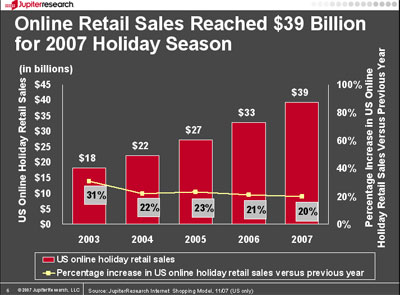
Bullet Point Review!
- Affiliate marketing will have to change and adapt with the general economic conditions.
- Weak dollar, housing value declining, tighter credit markets, rising retail prices, possible inflation.
- It’s a slow process for consumers to come back.
- Online retailing up 15% in 2008 (estimated).
- Online retail has been doing well, but starting to slow from economic down turn.
- Online buyer much more affluent than offline shopper.
- Online still going up because people don’t want to drive.
- 30% of consumers believe that they can get a better deal online.
- 36% of offline sales are influenced by online research.
- Expected to raise to 50% by 2012.
- 2008 – 6% of total US retail sales made online.
- More people looking for financial services online.
- Online retail sales reached $39 billion for 2007 holidays.
- Many CEO’s of multichannel retailers looking for growth.
- Expect a lot of free shipping offers, discounts, coupons, etc.
- Increase in number of people looking for free shipping online.
- Worth looking at ROI, but doesn’t necessarily create incremental sales.
- Harder to turn that free shipping/discount customer into a full price customer later on.
- Online ad spend is 1/10 of total ad spend.
- Printed ads are lagging in performance and are expensive.
- Merchants are looking for cost-effective alternatives in advertising.
- The pace of display ad growth is faster than, but no bigger than, search.
- Mostly due to advancements in targeting.
- Better value for the money.
- Seeing growth in new media experimentation.
- Advertisers prepare for rich media & video, less static banners & text.
- Affiliates are the ones taking the risk on the sale.
- 13% compound annual growth rate – $2.1 billion.
- Affiliate industry is growing at ~9%.
- Publishers need to be relevant!
- Never underestimate the ignorance of the government regarding the internet.
- Other states are looking at the NY Tax issue and to the online area for taxation over the next 18 months.
- By 2012, 51% of online shoppers will be female.
- By 2012, 56% will be over the age of 35.
- By 2012, 41% will have an annual income of $75k+.
- By 2012, 69% will be Caucasian.
- Now – online shoppers are affluent & Caucasian, split evenly between male and female.
- Don’t concern yourself too much about other languages now as most online shopping is done by English speaking individuals.
- Consumers are making fewer decisions before getting online to buy.
- Only 31% known the item they want before hand.
- Search in research process has grown.
- Fundamentally, social media is influencing decisions by way of reviews, but otherwise not having a large effect.
- Consumers are more likely to start the buying process at the retail site they want to purchase from.
- Over time there could be a paradigm shift to social media.
- Online buyers go to three sites on average during the buying process.
- Google increases solidifies it’s dominant position as top traffic source for most retail sites.
- Why do people go to other sites?
- 71% : To see other prices
- 41%: Like to shop around
- 29%: Looking for free shipping
- 29%: Looking for more product information
- 23%: To get a sense of what other people said about the product
- 23%: To check other sites offers
- 23%: To see expert reviews
- 21%: To validate product information already found
- Put what the people are searching for on your site so they don’t have to leave (i.e. include reviews, comparison pricing, product info, etc).
- Consumers trust reviews, spend more on those products, and become loyal.
- 69%: Impulse buyers
- 60%: Brand advocates
- 60%: Loyalist
- 52%: Directed buyers
- 48%: Overall online users
- Learn from reviews to create communication strategy.
- On average consumers come back to the site 2.5 times.
- About 20% of online retailers include “Recently viewed products” to try to cross sell other things the consumer already looked at (Amazon is the best example).
- Loyalists are not as profitable as customers (they’re just as likely to abandon in favor of a lower price).
- Use direct customer input to set achievable buyer expectations.
- About 60% of online retailers have persistent carts (i.e. when you leave the site & come back, the items are still in your cart or gives you the option to save items for a later purchase).
- The sooner you can give the customer information on incidental feels (shipping, handling, processing, etc) the better.
There was no time for any questions from the audience because it was so JAM PACKED with data and information. Every slide Patti shared had great graphics, which was kind of hard to concentrate on, but great for any data and analytic nuts that want to see concrete research represented in lovely chart format. I know this definitely inspired me to learn more about perfecting charts within Excel! Great stuff overall for affiliate managers and online marketers alike.
Read MoreOnline Marketing Glossary: Page View
Page View:
- The term for the loading and screen presentation of a single webpage.
This is the generally accepted criteria for a page view when measuring metrics and analytic on a website. It’s important that there be one standard like this because metrics can only be given universal acceptance and creedence when everyone understands what a page view is.
For example, if Software A registered a page view as the minute someone clicks on a link, that wouldn’t register as a page view in Software B using the above definition. So the same website could have an overinflated number of page views according to Software A than the generally accepted metric in Software B.
____
Glossary Definition From ABC’s of Online Marketing by Alexandra Wharton, Issue 22, Revenue Magazine
A Happy Blog Birthday to Me!
 In my hustle and bustle lately, I neglected to realize that I’ve been blogging “semi-pro” as I refer to it for a full year. I went back to see some of my earlier posts from last August and was reminded of this one – Hats, Hats, Everywhere! Could it be that it was just a year ago that I was still managing PsPrint’s mailing services? It’s also sad to say that I was “in charge of” social media marketing – a project that never took off on the company level, but I’ve obviously been running strong with it.
It feels like it’s been much longer than just a year that I’ve been at this, but I have to say that I’ve learned so much in a year that it’s incredible. In many ways this blog as served as a gateway to that knowledge and opportunities that I’ve been given. I’ll never be able to thank this little blog enough lol.
I wish I’d discovered Google Analytics sooner so I don’t have complete data, but thank you to the 16,000+ visitors this year that stopped by. Thanks for spending those few minutes to check out what I’ve been spewing out there into the webverse. I hope you’ve come by more than once. Told your friends. Subscribed despite my trials and tribulations in getting a freakin’ feed to work properly. And come by despite going through three URL changes…
Stay Classy, Interwebs.
Read More
Affsum Session: Content That Kills
By writers that kill! But it’s important to remember, as noted in my notes below, that content isn’t just the written word. It’s pictures, videos, widgets, everything. The panel consisted of:
- Lisa Picarille, Publisher & Editor-in-Chief, Revenue Magazine (Moderator)
- Angel Djambazov, OPM, Custom Tailored Marketing
- Kim Rowley, Founder, Key Internet Internet Marketing, Inc.
Overall it was a great panel, and Lisa did really well as a moderator despite unfortunately loosing her voice between last night & this morning.
Bullet Point Review!
- People want to write but they’re generally intimidated when they don’t have the “education” to do so.
- Passion & a unique voice are key.
- Ask yourself: how am I going to constantly update the readers & provide something new?
- Know your audience and craft your message.
- Ask your users for submissions.
- Contests are great – sometimes merchants will give you freebies to give away for the exposure & talking them up.
- Readers can tell the difference between reviews that are genuine and reviews that are written just to make a buck (hint: usually they’re overly talkin’ them up).
- Content isn’t just the written word, it’s also pictures, UGC, videos.
- Engage your audience & it will create content & ideas.
- Ask questions to engage readers.
- Be sure your ads contribute to your overall message – example given was a site for memorials for loved ones who’ve passed on with a banner ad for a popular dating service. Message FAIL.
- Design does contribute to the content, and can make it “seem” better.
- The design sets the tone for the content – a good example is TheDailyCandy.com – the design is fun & so is the content.
- Have some content that’s controversial…sometimes it gets more hits.
- Ping.fm is a great aggregate that lets you post across MANY social networks at once.
- Create an affinity with your audience.
- How do you get help? Ask knowledgeable family members, friends, users, and a professional outsource if necessary.
- What makes content the most compelling? Angel says be organic & open, be yourself, have some humor, & give a takeaway. Overall, be consistent! His example was Chrisbrogan.com.
Points brought up during the Q&A
- Keep video to 2-3 minutes max to keep attention – unless you’re damn compelling.
- Stories are better than iteration of tech knowledge.
- You need to get specific with your niche.
- Promote new blogs to the readers of your current blog.
- Passion resonates.
- Archives need to be accessible and easy – if I just found you & really like your blog, I’ll want to see what you’ve written about before.
- Effective to use analytics to understand how your audience interacts with you. It helps narrow down the sweet spot of your topic.
- Use WordPress plugins to your advantage to highlight the most popular posts.
- ShareThis is a great tool.
It was totally great!
Read More


