

Web 2.0 Expo: my.barackobama.com: The Secrets of Obama’s New Media Juggernaut
 Session Description: Marketers and activists alike have taken notice of the strategies and tactics that helped put Barack Obama in the White House. Jascha will discuss the tools and techniques used by the presidential campaign’s record breaking online efforts. In addition to telling the inside story of the campaign’s online engagement efforts, he will also discuss how these strategies and tools can be applied to a variety of other sectors beyond politics.
This session took place Friday, April 3, 2009. The speaker:
- Jascha Franklin-Hodge, Blue State Digital
This was a great session and was packed to the gills with people, of course! The My.BarackObama.com site has been hailed as one of the chief reasons Obama won. It was great to hear the creator of this site speak.
Bullet Point Review!
- Blue State Digital – design, technology, strategy.
- Obama 2008 By The Numbers
- 1 billion emails to 13 million email addresses.
- Over 1 million SMS subscribers.
- 200,000 offline events planned via the website (non-official).
- 35,000 local volunteer groups.
- 14.5 million YouTube viewing hours (this is a conservative estimate; it doesn’t include embedded or UGC.). This would have cost $40-50 million had it been traditional, purchased air time.
- $770,000,000 raised (35% offline, 65% online).
- Professionals tapped into the grass roots efforts.
- How we did it?
- Drive Action
- No such thing as too much email, just too much unwanted emails.
- Match the action to the medium.
- Doesn’t work to just shoehorn your existing web experience to every medium.
- Set high expectations.
- Be Authentic
- No Press Releases and people don’t read newsletters.
- Personalize communications
- Example: personal note from Al Franken after donation.
- Go behind the scenes.
- Create Ownership
- Turn users into advocates.
- Traditional donation matching is one wealthy donor <-> existing + new donors.
- Grassroots donation matching is existing <-> new donors.
- It’s not about me + large organization; it’s about all of us together.
- Recognize your leaders and engage them.
- Invite people to participate.
- Create user content and share the best.
- Solicit ideas from people and use the ones that make sense.
- Connect people with each other.
- Be Relevant
- #1 Obama fundraiser: Sarah Palin.
- Within 24 hours after the end of her first speech, campaigned raised $11 million via email and some organic donations.
- Don’t just react, anticipate.
- Build a Strong, Open Brand
- Brand professionally
- Brand consistently (don’t forget your plane!).
- Empower people to do interesting things.
- They might paint their barn.
- Or illuminate their bike.
- Or create iconic artwork (Shepherd Ferry HOPE Poster).
- Measure Everything
- Emails, online advertising, engagement, fund raising, persuasions, election activities.
- Do at least A/B Testing, if not multivariate.
- Drive Action
Points brought up during the Q&A
 Have you considered a grass roots tool kit for local organizations?
- As a business, Blue State Digital isn’t at the point where they can do that.
- 1 or 2 most unexpected lessons?
- How important it is not to underestimate people.
- Was there also traditional marketing to drive people to the website?
- Not really, but there were Google PPC ads.
- What one thing would you have fixed retrospectively?
- Start earlier and work on scalability. Build with a longer term vision in mind.
- If the other side level the tech playing field and catch up, will Democrats keep an advantage?
- Yes, Republican’s challenge isn’t the tech, it’s their culture.
- They need to recognize this cultural gap before they can keep up.
- Democrats will keep innovating to keep an advantage.
- Did you measure demographics?
- Yes, average age of website user was 37. Surprised by age diversity.
- Bounced ideas of his own mom to make sure they appealed to a broad audience.
Overall this was a great session to end the conference on.
Read MoreWeb 2.0 Expo: Towards a More Open Union: Ways for Us to Change America
 Session Description: We have a unique opportunity now, as developers and designers to change our Government. From the FEC to Recovery.gov, new sources of data are beginning to pour out of Capitol Hill and state houses across the country. What kind of opportunities arise? But how do we developers use our skills to make this data compelling, useful and open. Sunlight Labs director Clay Johnson will discuss the story so far with Government data, where things are headed, and how you can help.
This session took place Friday, April 3, 2009. The speaker:
- Clay Johnson, Sunlight Labs.
So this was much more of a call to action on the part of developers, but it had some take homes for everyone.
Bullet Point Review!
- The Landscape
- Barack Obama “transparency and the rule of law will be the touchstones of this presidency”.
- Harry Reed “it’s time for open government, transparency, and it’s a time for results”.
- Nancy Pelosi “the internet is an incredible vehicle for transparency, honest leadership and open government”.
- John McCain “ethics and transparency are not election year buzz words; they are the obligations of democracy and the duties of honorable public service”.
- Democrats: helps keep the majority, rep helps take back the majority.
- Transparency makes healthier government.
- Wubbahed.com
- As they become more digitally immersed, they ask for less money in earmarks; digitally immersed = ethical?
- Recovery.gov powered by Drupal
- Transparency Opens Markets
- Open data coming out of the government is helping to increase markets for commerce (Google Maps, Weather.com are examples).
- Transparency Saves Lives
- FDA made a widget regarding the salmonella outbreaks.
- The Problems
- We have to meet the president half way.
- Public means online (a warehouse open in wash dc doesn’t cut it).
- We can’t afford to wait on government to get their stuff cleaned up.
- Sunlight Labs is a community of 466 (so far).
- How You Can Help
- Coding>Consensus
- If you do it for them, they’re faster to adopt than they are to decide to adopt.
- We don’t have much time.
- Every politician is kowtowing to transparency. May change by January next year when people start running for election again. Only have about 9 months to push the ball as far up the field as it’ll go.
- Issue -> Movement
- Be an Organizer
- Make sure people know each other’s names.
- Move them into the physical space.
- Make specific requests, but check your ego at the door.
- Convene a Hack-a-thon in your area.
- Parse a State (50 State Project)
- The laws your state legislature are passing are far more important.
- More local = more listening.
- More local = less technology.
- Redesign an Agency
- Federal websites are heinously ugly.
- Draw a picture for them of what their websites should look like – see them want to adopt your designs (Examples: USA.gov, Federal Elections Commission).
- Visualize Data
- CIO of the Federal Government wants to create data.gov with all the feeds and data.
- Visualizations tell stories.
- +1 Our Community
- Spread the word about Sunlight Labs to developers and hackers.
- Sunlightlabs@googlegroups.com
- Wiki.SunlightLabs.com
- Working on standardizing nomenclature in government documents (e.g. walmart, wal-mart, wlmrt all used in various documents, making searching hard).
- Steal this presentation
- Sunlightlabs.com/ignitepresentation
- Be an Organizer
- Coding>Consensus
Points brought up during the Q&A
- What can non-developers do?
- Join the list; it’s an open forum. Some stuff you might not understand but there’s other stuff you can help with.
- How do you solve the warehouse full of paper issue?
- A big scanner 🙂
- Some are handwritten scans and using volunteers to manually enter this data into a database.
- Data and technology will get us 80% there, the rest are actual eyeballs reviewing things.
- How can government help facilitate this?
- Bulk access to the data.
- API, rest based.
- Compelling user interface for ordinary citizens (IN THIS ORDER).
- Have you explored the limitations of transparency (money, CIA, DOD)?
- They’re not into hacking the FBI, they’ll know when they’re successful when the EEF complains about what they do. For the time being they’re allies. There are limits they tend not to cross. They know what info is sensitive and not to put online.
- Start with the open data and then remove what might be private, not the other way around.
Despite not being a developer, some of this is stuff that we can all pass on to our friends who ARE developers and attempt to make a difference.
Read MoreWeb 2.0 Expo: Making Government 2.0 a Reality: A Citizen’s Guide to Essential Reforms
 Session Description: The potential for Government 2.0 is both real and exciting: technology-wise, we can now cheaply and efficiently enable a government that is transparent, participatory, collaborative, and effective. But there are some very real, very stubborn obstacles in the form of outdated laws, regulations, and policies. Andrew will outline these barriers, and set forth an agenda for reform.
This session took place Friday, April 3, 2009 and kicked off the Government 2.0 track of sessions. The speaker:
- Andrew McLaughlin, Google
This was a fascinating session, and Andrew did his best to cover what he did to assist with the transition committee, Tigger, to transition President Obama into the White House. Andrew dedicated his personal time, taking three months off from his job at Google to commute to Washington DC during the week and back home to the Bay Area on weekends, from Election Day to Inauguration Day, to help.
He used a really cool software called MindMap (I think) that he actually said was proprietary, but it was basically an outline on steroids, so forgive me if there are a LOT of notes; I tried to get everything, but I’m sure some might not make sense.
Bullet Point Review!
- The promise: transparency, participation, collaboration, efficiency & effectiveness.
- Get a better government; spend less money.
- Some Examples:
- DC: CapStat Mapping Application
- Puts government data in citizens’ hands in real time.
- Key facts:
- All 911 and 311 reports are viewable online, same day, with full tracking to resolution.
- Every city agency must provide public data feeds; now more than 260 live data feeds.
- 2008 year to date homicide rate down 19% over 07.
- Mapping applications
- DataCatalog
- Apps for Democracy
- DC Stumble Safely
- Virtual Alabama
- Emergency response platform becomes backbone of statewide gov collaboration and performance.
- Changed government culture across the state to reward sharing and use of data, rather than hoarding and ownership.
- Emergency response platform becomes backbone of statewide gov collaboration and performance.
- Now used to improve operations in all kinds of ways not originally envisioned.
- Key facts
- Total cost $160k + 2 staff.
- Supports 550 agencies.
- 10 days from decision to functioning system.
- Enables state to mothball expensive emergency operations center, saving millions.
- Uses Google Earth geo platform.
- Can be used by governor and police/responding agencies.
- If you want access to this, you have to give us your data in real time and keep it updated – has worked well.
- Hopefully positive political pressure will also en courage participation.
- Virtual Alabama
- Washington State Dashboards
- Since 2005
- 93% of highway projects completed on time, 95% within budget.
- <24 hour response time to child abuse calls went from 69% to 95%.
- Doubled job placement rates.
- Lowest traffic fatality rate in history.
- Data driven management isn’t new; what’s new are the cheap, powerful IT tools that drive performance.
- Since 2005
- SeeClickFix
- Lets you create an area to monitor reports of complaints.
- DC: CapStat Mapping Application
- The Obstacles:
- Acquisition and procurement.
- Federal procurement.
- Must government use of free online service be subjected to a competitive bidding process?
- Gratuitous service agreements for free apps.
- Library of Congress iTunes, Flickr, YouTube
- GSA: YouTube, Flickr, vimeo, blip.tv
- Advertising: agencies are restricted from carrying advertising for private individuals, firms, or corporations (so if it’s ad supported, can’t use it).
- Government subject to terms and conditions, but has to individually evaluate and perhaps not be subject to those.
- Indemnification
- Anti Deficiency Act
- Federal contracts can only provide for ltd indemnification unless a specific statue provides otherwise.
- But conventional website boilerplate terms and conditions like Google, YouTube, provide for unlimited liability.
- Example: The VA wanted to use Second Life to rehabilitate vets.
- Linden Labs contract specified unlimited liability, so had to have a special contract drafted.
- Anti Deficiency Act
- Legal jurisdiction and venue.
- Federal agencies are governed by fed law. Agency GCs won’t sign contracts that bind them to state law.
- Most internet companies terms define legal jurisdiction in a specific state.
- Federal procurement.
- Access
- Employee access and use of social media.
- Acceptable use of Facebook during work.
- Some agencies prohibit use of social networking and other web 2.0 sites.
- Need to establish a presumption.
- Disabled Access
- Needs to be equally accessible for disabled and non disabled
- Can the government sign a contract with a web service that is not section 508 compliant? If so, how to ensure equal access to info for disabled employees and citizens?
- Freedom of Information Act
- Challenge if iterative media
- How many versions of a document are subject to FOIA requests?
- Danger of disclosure of user login data, which would discourage citizen use of web tools.
- Need to clarify that personal data is exempt from FOIA.
- Challenge if iterative media
- Employee access and use of social media.
- Privacy and Security
- Privacy
- OMB circular on cookies.
- Prohibits federal websites from using persistent cookies unless certain conditions are met.
- Persistent browsing.
- So federal web can’t remember preferences or settings, or gather web analytics.
- Needs to be fixed to enable persistent cookies while protecting citizen privacy.
- Prohibits federal websites from using persistent cookies unless certain conditions are met.
- 3rd party websites and embedded content.
- OMB circular on cookies.
- IT Security
- Malware, spyware via web 2.0 use, threat to agency networks and citizen personal information.
- Every technology platform adopted by the government must undergo a rigorous security review.
- Federal Information Systems” included.
- Privacy
- Management Statuses.
- Paperwork Reduction Act
- Requires some forms of web 2.0 information collection to undergo a time-consuming OMB clearance process.
- Example: solicitations of input and ideas to improve government that involve particular data about users.
- Stories and Experiences
- Public engagement tools can trigger OMB info collection requirement and approval process.
- Example: solicitations of input and ideas to improve government that involve particular data about users.
- “Public Information Collecting Activities”
- Example: TSA blog’s use of a survey.
- Requires some forms of web 2.0 information collection to undergo a time-consuming OMB clearance process.
- Presidential Records Act
- Requires preservation of all written white house communications.
- “Document Material” = records
- When is a wiki doc or online comment forum final and thus is a “record”?
- Electronic records must be kept in written form.
- Printer overload
- Requires preservation of all written white house communications.
-
- Need to enable electronic storage of web-based records.
- Official websites like WhiteHouse.gov
- Official postings on third party sites like YouTube videos, Flickr photos, Facebook status updates.
- Need to enable electronic storage of web-based records.
- Paperwork Reduction Act
- Commercial Endorsement
- Advertising supported 3rd party sites?
- YouTube
- Exclusive use of a single service?
- They do redundancy of services.
- Advertising supported 3rd party sites?
- Acquisition and procurement.
- A Reform Agenda
- Laws, regulation, rules
- Takes time.
- Sometimes there are statutes that require the cooperation of Congress, etc.
- Culture
- People -> Send Good People
- President Obama really personally “gets it”.
- People -> Send Good People
- Laws, regulation, rules
Points brought up during the Q&A
- GMAP really fantastic management process but still needs work; not really parsable.
- Wonderful in theory, hard to manage in practice.
- Now considered mandatory in campaigning to have a great website with lots of awesome content.
- User interface always lags behind the back end.
Especially with my involvement of late in lobbying in Sacramento against legistlation that could really hurt my industry, this session hit home for me and convinced me to stay for the rest of the Government 2.0 sessions that day.
Read MoreWeb 2.0 Expo: Day 1 Keynotes
Most conferences I’ve been to have one keynote for the entire conference, maybe one keynote per day. This conference had a bunch of keynotes all in one big block – every day! On the official Day 1 of the conference, April 1st, they had the keynotes in the evening after the sessions and before the cocktail reception, sponsored by Palm. The other days the keynotes were in the morning. I made it to the keynotes on the 2nd, but not on the 3rd, so those notes are coming tomorrow. Without further ado, here is a recap of some random notes I took during the first day’s keynote sessions.
Tim O’Reilly, O’Reilly Media: O’Reilly Radar
- Google figured out how to extract additional data.
- Able to extract meaning.
- Starting to see coordination of electronic sensors.
- A meaningful names pace is a very powerful tool.
- Meaning doesn’t have to be formalized.
- The energy signature of major appliances are so unique you can identify the make/model by the energy surge.
- We’re getting beyond the point where the web is just fun and it’s starting to work.
- Web 2.0 + World = Web Squared
- History is on a different course because of someone being able to understand how to apply technology (President Obama).
- The Power of Less
- Take what we’ve learned with the consumer internet and apply it to hard problems.
- Build a simple system – let it evolve.
- Create more value than you capture.
- Continue to create, invent, and make value.
John Maeda, Rhode Island School of Design: “Open Source Administration”
- Developed the laws of simplicity.
- Forever Stamp the perfect example of simplicity of design.
- Technology makes things happen at light speed.
- The pendulum swung towards tech and now it’s swinging back to humanity.
- RISD is a traditional art and design school.
- Perfect symbol for American innovation.
- Used to have a hierarchy of leadership tree, turning into a network that you can talk to anyone in.
- Creative Leadership:
- Leading Creatively – example Steve Jobs
- Google creative leadership
Stephen Elop, Microsoft Business Division: A Conversation with Stephen Elop
- People are bringing in different perspectives.
- Has the benefit of learning from other areas of the business.
- Taking on the cloud: Microsoft working to combine offline.
- Will there be MS Office apps for the iPhone? Keep watching!
- Beta code for Office online soon (maybe next year).
- Software plus services.
- Sharepoint is the fastest growing product in the history of Microsoft.
- If they redo any interface, half a billion people use the products and would have to re-learn the software.
- OneNote is like Word on crack.
- Microblogging – will Microsoft get into that? They’re experimenting with it and blogs.
- There’s a joke that Microsoft is the evil empire, so Stephen gave Tim a “I am the Empire” shirt people around the MS campus have been wearing lately.
Amanda Koster, SalaamGarage: Imagine What You Can Do
- Telling stories that will make a difference in people’s lives.
- She told the story of a little girl and what it’s like to go on a SalaamGarage.com trip.
- Tell someone’s story through you, through your social media.
- Use your influence to educate to make a difference.
- It’s all for amateurs; not for professional photographers.
- They’ve used ReveNews
- It’s not a broad message, it’s one little girl, that you met, whose story you can share.
Michael Abbott, Palm, Inc.: High Order Bit
- New Palms run on a web OS
- Cards – multiple apps running at once.
- Palm Synergy – bring the data together in a single place.
- Notifications – notice manager.
- Web OS platform built with HTML, Java, and CSS.
- Doesn’t require a server to run.
Tim O’Reilly had very engaging and interesting things to say, and I loved listening to John Maeda’s presentation. Stephen Elop seemed to be on the defensive a little during the Q&A portion of their conversation, and what he said kind of ran on a little and I tuned out unintentionally. I appreciated Amanda’s passion and I really like what they’re doing at SalaamGarage, but towards the end it did sound like a Save the Children commercial. Finally, since I have a Blackberry that I love I kind of tuned out Michael’s commercial for the new Palm Pre, but it DID sound like a pretty handy little PDA.
I’m glad that they made the video of John Maeda available and I wish they’d have made the video of Amanda Koster available too, because they were both good speakers.
Read MoreMayor Cory Booker on Real Time with Bill Maher
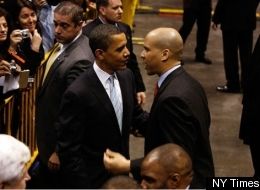 I’m sure I’m not the only person that’s really taken note of Newark, NJ Mayor Cory Booker since his moving keynote at Affiliate Summit East 2008. Last week, Booker appeared on Real Time with Bill Maher and gave a great interview on what an Obama presidency means to him and to America. It was very reminiscent of the keynote speech – inspiring and motivating – so I felt it best to share. Remember that his words can inspire you on a number of levels – which can boost your motivation to chase your own American dream and work harder to reach your goals in both business and pleasure.
I’m a Bill Maher fan from way back in his Politically Incorrect days, and I was glad that he seemed to really appreciate what Mayor Booker had to say and, apart from the occasional jabs about not having to ask a question before Booker spit out an answer, he was a really gracious interviewer. Among some of the inspiring things he had to say, here’s one of the better nuggets:
We, as Americans, drink deeply from wells that we did not dig. This generation that I live in had so many sacrifices of those who’ve come before us, and the best thing we can do is show some measure of sacrifice to honor those people who bled on beaches from Normandy to Midway for us, or who stood on line to register people to vote back in the day that you could get killed for doing that. So, I’m not about a position. I’m really about a purpose, and I think we are a purpose-driven country. And I think it’s time that we exalt all of the spaces of our nation, that we honor the sacred nature of human dignity and human life, and try to make the idea of democracy more emboldened and more inclusive, so that all of us enjoy the fruits of this great nation.
You can listen to the entire episode (140) as a podcast through iTunes. Here’s the video clip of the segment with Mayor Booker via satellite on Real Time with Bill Maher:
Read More


