

ASW10 Session: Product Datafeeds: The Next Level
Session Description: Product datafeeds are among the most powerful tools available to affiliate marketers. We’ll discuss the current state of datafeeds and industry progress, best practices, and moving toward standards. The panel consisted of:
- Scott Jangro, President, Mech Media Inc. (Moderator)
- Larry Adams, Product Manager, Google
- Shergul Arshad, VP Business & Corporate Development, StyleFeeder, Inc.
- Brian Smith, CEO & Founder, SingleFeed
The panel was really well organized. Scott asked questions and then each panelist answered. I did my best to note the questions Scott asked and who each answer came from.
Bullet Point Review!
- Have you seen innovation in datafeeds?
- Larry: Haven’t seen a lot of innovation on the advertiser side, but have seen innovation from publishers. Deriving interesting information from feeds to actually provide some value. Taking this huge library & simplifying it. GAN is trying to figure out how to make the data more accessible & easier to consume. Easier for the publisher to get what they want out of it. The networks’ role is to be a facilitator. They push advertisers to get highest quality data and make sure as many publishers who want the data can access it.
- Shergul: 30% of the datafeeds they work with are truly excellent, 40% just acceptable, and the rest they have to mess with. 30% aren’t in the right format, and not just smaller programs but some are from big retailers. They’re on a campaign to try to help improve this and they reach out to the merchants. Sometimes merchants need to be shown what they’re missing by not providing accurate data. It’s easier for people to take advantage of open source tools to innovate so more people want to access datafeeds to automate sites. It’s hard to envision a one-size-fits-all datafeed.
- Brian: Not much has changed, but in the last 18 months datafeeds have become more complex. More attributes are being asked for from the merchants. That’s a good, positive sign. It does kind of screw things up for merchants trying to format new feeds in different formats. Merchants are starting to recognize datafeeds are great, and they’re looking for the next great channel. NOw they’re being forced to deal with datafeeds.
- There’s been more development of product APIs instead of downloading text files. Is API going to take over datafeeds?
- Shergul: API are more accessible when you’re pulling in fewer feeds. Using thousands of datafeeds just isn’t scalable. There’s a place for coexisting, but in general for speed and size constraints, they can’t shift towards APIs.
- Brian: Some publishers don’t know how to use APIs, so it’s going to take awhile for publishers to move over there and mostly they’ll coexist for awhile.
- Larry: The nice thing about an API is the data is fresher. GAN integrated with Google Base because they have a nice API. Working to provide more keyword targeted ads.
- Scott: Data has never been more accessibly and most networks now offer free access.
- If someone is just starting out, how should they start?
- Larry: Start small. Deal with usefullness before scale. Find out who has the best feeds and start easy. Figure out how you’re going to use them & then you can figure out ways to imprve the bad data or ignore it until the advertiser provices high quality fdata. Literally tens of millions of products are available to you. You don’t need every single product on your site to have a good user experience. There’s a fine line between copying and searching for inspiration. Don’t do what your competitors are doing – but shop there and find what you like and dislike in the shoes of a consumer and improve upon that.
- Shergul: It depends on what your site does. It’s manageable to access the “right” 20 datafeeds to be comprehensive in your vertical. Too man products can get too big and too overwhelming too quickly.
- Brian: Go after high quality. You might as well start with APIs and they have a wealth of information you can access. Make some calls & learn more about them. Start from there. Look at the big guys pushing great data – Amazon, eBay, Shopping.com.
- What are the major hurdles in getting “good datafeeds” to a higher number?
- Larry: That’s more of a merchant problem than a network issue.
- Brian: The networks need to sell datafeeds better. Case studies will work.
- Is there hope for standardization? Can we? What does it really mean?
- Larry: The first thing that comes to mind is categories. Building a common taxonomy that works for millions of products and thousands of merchants.
Points brought up during the Q&A
 Shergul: Positive examples of great datafeeds and data quality: Nordstrom, Shoe Buy, Target, CSN Stores.
- Larry: It can seem like a daunting task to improve a feed, but start small with one category to see if there’s a payoff on the work you’ve put in. Then you can more easily convince your boss it’s worth the time.
- If you have duplicate products, would you suggest changing the descriptions to avoid dupe content?
- Use your own analytics to pick the best product and dump the other one; there are enough products that you don’t need to worry about using both.
I hope I got comprehensive notes. I was trying my best to pay very close attention, but I have to admit that I got lost in some parts. By nature, it’s a dry subject, and though the presenters were doing their best to keep it lively, that early of a time slot might have not been the best. Here’s the presentation:
Why Was My Affiliate Application Declined?

I hear a lot of affiliates ask this question, wondering why their applications to some affiliate programs are declined. As an affiliate manager, there’s a lot of reasons why I might decline an affiliate application. I’m a very responsive affiliate manager, and will always answer this question when asked, however I know there are many managers out there that are, shall we say, less than stellar in the communications department. In an effort to bridge this gap, here are some things affiliates should consider when they come to ask an affiliate manager, “Why was my affiliate application declined?”
Are my website URLs correct?
I’ve seen instances where affiliates have misspelled their domain names accidentally, added an extra http://, left off the extension (.com? .net?). Many affiliate managers are, of course, savvy enough to just omit the extra http:// or try adding the .com to see if a website comes up, but I know some are not so diligent, so it’s best that you make checking your websites as easy as possible for the affiliate manager.
Have I been declined a lot?
There may be a bigger issue at hand, like your website’s hosting company being down or your pages not loading correctly. If you’re having your affiliate application declined a lot, you should check to ensure that all your sites are up and running and displaying properly. Try viewing your website in different browsers (Firefox, Internet Explorer, Chrome, etc) to see if something isn’t loading correctly. Some affiliate programs are very sensitive to the content and look of a site where their advertisements will potentially be seen.
Do I have any unprofessional or questionable content on my website?

Some brands are much more sensitive when it comes to the content on a website where their ad will appear. For example, the Apple Store has very strict guidelines relating to website content and where you can and cannot place the banner advertisements for the Apple Store. Larger brands tend to have more guidelines regarding their advertising, and may choose to decline you if your websites do not convey a likewise professional image that is on par with the brand. You can consider changing your website, removing the possibly unprofessional content, or finding an alternative merchant with more lenient standards on the website content.
Are all my websites listed in my profile?
Of course, some networks like LinkShare and Google Affiliate Network give you a separate profile to apply per website, so this isn’t necessarily a blanket issue. But in other networks, this may be a detriment not to list all your sites. Often affiliate managers are checking the affiliate’s websites and looking for a good niche or category fit. If you’re applying for a sports gear affiliate program and only have your knitting website listed, the affiliate manager may not see a good fit and choose to decline you. Having all your websites listed shows the affiliate manager that you work in different verticals and they can see more potential for appropriate promotions. Personally, I don’t know why an affiliate would ever not list a website unless it was less than ethical, but please comment if you have a good reason for not listing all websites.
I’m sure there are hundreds of other individual reasons why you might be declined. Some affiliate managers really check content for a good niche fit, while others allow multiple categories in. It all ultimately depends on the merchant and if their product would appeal to a wider audience or a more narrow audience of customer. Always attempt to reach out to the affiliate manager if you’ve been declined for a program you really want to promote. Most of the time you should receive some kind of response, either explaining why you were declined or giving you a chance to promote the program.
Read MoreAffsum Session: NY Tax Laws – Issues & Solutions
Unfortunately I was a bit late to this session today, but I got a lot of good info in the 40 minutes I did attend. The panel consisted of:
- Adam Riemer, Director of Marketing & Client Relations, Downtown Ecommerce Partners (Moderator)
- Chris Henger, Group Product Manager, Google Affiliate Network
- Kim Rodgers, Affiliate Manager, 4Checks.com
- Melanie Seery, Affiliate, NY Affiliate Voice
- Clarke D. Walton, Internet Lawyer, Walton Law Firm, P.C.
First I do have to comment on the panelists – I had the pleasure of hearing a session at ASW08 where Clarke spoke on internet taxes in relation to affiliates and I have to tell you – this is the kind of lawyer you want in your Rolodex. He’s extremely internet and tech savvy, which is always good when you’re talking about internet law. He has experience doing affiliate marketing himself, so he can totally relate to your issues. And he clearly knows his stuff.
Speaking of really knowing their stuff, Kim Rodgers is the ace affiliate manager who really knows what she’s doing, and has built her program up SO much it’s phenomenal. I had the pleasure of sitting with her last night at the Affiliate Dinner (more on that later) and she really is a great AM and has the unique experience of being in the position of a company that initially culled their NY affiliates and now, after some changes internally, are able to welcome them back and have to regain their business (not to mention their trust).
So, the bullet point review of the panel:
- Networks can’t really give any advice to affiliates legally, so they’ve pretty much had to stay out of it.
- Early in July, California explored the NY law and determined that affiliates don’t prove nexus, hence pretty much saying the opposite of what NY is. Hopefully for those of us in California this means that they’ve gotten it out of their heads to try to mimic this.
- Late in July the NY state senate approved a motion to repeal the tax, so while there’s not much news about this yet it’s a step in the right direction in terms of a repeal.
- It’s important for affiliates to be willing to comply and work with their merchants to get through this and maintain a good relationship.
- Affiliates in NY will have to give up a little privacy (like their NY address) in an effort to comply.
- Merchants can simply add a small paragraph into their terms of service that NY based affiliates need to agree to specifically to comply with laws.
- Affiliate managers need to follow up with the NY affiliates to make sure they’ve read the modified TOS and agree.
- Merchants who kicked NY affiliates right away probably have a better chance of wooing them back than merchants who waited until the middle of June and then deactivated the NY affiliates retroactive to May 31st. Melanie’s opinion? “They don’t have a prayer.”
Some take-home answers from the open Q&A:
- The law applies to merchants based in Canada as well (unfortunately I couldn’t hear if they said it applied to international merchants too).
- The law is not clear if nexus is established when a merchant has affiliates who make $10,000 per year aggregate or per affiliate.
- Affiliate managers should not encourage their affiliates to incorporate their businesses in other states. This is a poor work around (it’s not a solution) since, well, what if that state’s next to adopt a similar law? You can’t keep reincorporating and it’s basically fraudulent anyway.
- The state of Washington has come close with a similar law affecting internet sales and taxes. Formerly, the tax rate on an internet sale was calculated based on where the merchant is located. Now, it’s calculated based on where the order is shipping to. This only applies within the state – for now. (As an aside, I know that the California law is already like this and bases tax assessment on the shipping address, being that PsPrint is based in California).
- The federal government is also looking into these laws since we are talking about interstate commerce and may make a move soon, but it’s hard to say in what direction that move will be.
If you caught anything I didn’t (ahem 11|15 Media’s Michael Buechele), please share with the rest of us!
Read MoreCribbed Content for July 4th
Happy Independence Day! You should be out enjoying a parade, a nice BBQ, or some spectacular fireworks! I’ll forgive you if you’ve chosen to give my innocent blog a quick view amidst all the celebration though ;).
- A few months ago, Google officially acquired DoubleClick Performics, an affiliate network. This week they’ve rebranded as Google Affiliate Network. Shawn Collins wrote up his perspective on this – definitely seems to be a step in the right direction for the reputation of affiliate marketing.
- Last week I mentioned an irresponsible attack on the PMA by Shoemoney. Swift to clear up any confusion, the team posted What Exactly Is Affiliate Classroom’s Role in the PMA?
That’s it! Go forth and have fun this 4th!
Read MoreCJ Jumping into SEO?
I logged into Commission Junction today to see this:
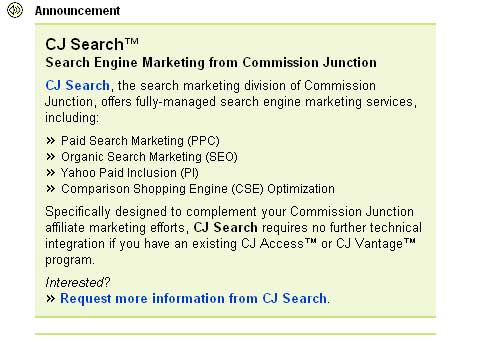
The timing of this is pretty curious, if you ask me. Right on the heels of Google Affiliate Network and their declaring that they’re 86’ing the referrals. So what’s up now Calacanis – SEO still bullshit?
Read More


