

A TrishaLyn.com Redesign! Yay!

Things look different around here at TrishaLyn.com (unless you’re reading this through a feed reader, then things are pretty much the same…)! I finally found a new theme from the fine folks at Elegant Themes that I’m happy with. It’s simple, but I like the top navigation and right hand sidebar WAY better than everything being on the left. I don’t know, it just seems more classic this way!
Read MoreCJU Course: Consumer Shopping Trends: What makes them tick? What makes them click?
The Internet has become the main purchase path for many consumers so let’s uncover the latest trends and developments in online shopping and learn about what is making consumers click “Buy Now.” How are innovations in mobile, local, and social changing the shopping experience? What is the real impact of coupon and deal sites? Join us to discuss what is driving changes in shopping behavior, who is buying and why, and most importantly, how affiliates can continue to be at the center of these trends. The speaker was:
- Ronan Vance, Director, Business Development
This was a great last session to end on. It was chock full of information – if you were an attendee of CJU and didn’t get a chance to check out Ronan’s presentation, I highly recommend you access the CJUniverse for his presentation PDF. There’s so much more information in the form of great charts that I can’t really include here. I love it when presentations have lots of interesting stats, and Ronan sure didn’t disappoint!
Bullet Point Review!
- Where to buy? Lots of different ways to buy.
- The times they are a-changin.
- Early 20th century: personal, social, immediate, informative.
- Late 20th century: variety, experiential, social, immediate.
- Early 21st century: variety, convenience, transactional, informative.
- Understanding the online shopper.
- Buying more online, 30mil new shoppers online. 5.8% of total retail sales in 2010 (eMarketer). Forrester says if you take groceries out of the equation it’s more like 12%.
- Top reasons us shoppers will shop online: 24 hr shopping, easier to compare prices, free shipping offers, I don’t want to fight the crowds, more convenient to shop online, easier to find iems online, better variety online, I often don’t have to pay tax.
- Three hot trends that continue in 2011.
- Coupons
- Despite challenging economic conditions, people are still shopping online to get the best deal.
- More people are price comparison shopping and printing coupons online than looking for jobs.
- Couponing has become part of our culture.
- Maximize coupon usage: give choices, diversify placement, remove obstacles, promote sharing, go mobile.
- Adult mobile coupon users. About 19.8 mil today, est 35.6 mil by 2013.
- Daily Deals/Deals of the Day
- Fleeting, play into your emotion because people feel they need to take advantage of the opportunity that they’ll never see again.
- Groupon and LivingSocial have ~40% of the group/ daily deal market.
- Very social aspect. Over 80% of Groupon subscribers will share a deal in some way, shape, or form.
- 77% of deal buyers for Groupon, LivingSocial, BuyWithMe, Travel Zoo are new customers, 36% spent beyond the deal value, 68% returned to the establishment and bought again without a coupon, 20% became return customers, 22% were unredeemed (Source: Rice University Survey)
- Social local mobile (SoLoMo)
- F-Commerce? Commerce on Facebook.
- Discovery + eCommerce + community = future of F-commerce.
- Local apps (Foursquare, Gowalla): check-in, find deals, build loyalty, earn rewards, get instant gratification.
- Mobile: check stock, compare prices, find coupons, learn more, read reviews, shop online, phone in order.
- What’s next?: Informative, Experiential, personalized, social, immediate.
Social Media Marketing Summit: Mobile Marketing
The topic set forth is mobile marketing and social media’s impact. Unfortunately, through no fault of the organizers, the panelists fell way short of linking mobile marketing to social media at all. My laptop battery died at the beginning of this last session, so I was unable to post it right away like all of the other panels today.
- Amielle Lake, Co-Founder & CEO, Tagga.com
- Ben Bajarin, Director of Consumer Technology Practice, Creative Strategies.
One of the first things that Amielle said is that neither of them have very much experience with mobile marketing, and she tried to use this as an example of how new a medium this is. Sorry, that just discredits you right away as not knowing what you’re talking about. There were a few points, but I was less than impressed.
They were very clearly unprepared and ended what they were talking about (which had nothing to do with social media) rather quickly and opened up for audience questions and anecdotes. Some of the audience members even seemed just as qualified to speak about mobile marketing as the panelists, and the panelists looked like the questions confused them at times. To their credit, some of the questions were incredibly detailed and long winded, so perhaps they just didn’t know how to approach them right away.
Bullet Point Review!
- Advertising industry as a whole has been looking to just re-purpose current content for mobile instead of doing something innovative.
- There’s been a rise in the number of people who own smart phones.
- Smart phone advertising needs to be contextual.
- Devices are using the web as a common feature.
- We are very far behind globally in mobile technology in general – Asia is in the lead, and Europe is even significantly more advanced than the US.
Points brought up during the Q&A
 Does the 45+ crowd just not get it? They’re learning; there’s definitely a slower adoption process.
- How do you serve ads with any quality? Amielle answered with a plug for her company.
- What are the challenges in dealing with various carriers? They will eventually want a piece of the action, but right now the biggest hurdles are technology – you need to use an SMS aggregator who’ll set you up with the short code and do the wheeling and dealing with the carrier for you. They cost a lot of money up front, take 4-6 months to get set up, and then charge a monthly fee on top of that.
- Mobile marketing has incredible potential to be highly targeted and sophistically geotargeted.
- US carrier structure is very different from Europe and Asia’s.
- SMS content is definitely more appreciated by consumers, so you have to give good content for any kind of advertising along side it to be acceptable.
- Hard to satisfy broad interests – some interfaces will be more appreciated than others by various groups and individuals. Can’t please everyone.
- Is there a tool that will aggregate campaigns and marketing across different channels like mobile, social media, email, and possibly integrate them? Nope, but that would be great (thank you for that stunning report, Cpt. Obvious).
- Are there standard tools to filter the incredible amount of user data? Actually, data being collected now is limited to carrier, type of phone, time of interaction, click-through if there’s a mobile site, very basic stuff. There are ad platforms that can assist in targeting your ads to the right audience.
- It will get better, but more precise data with demographics and geographics isn’t there yet.
Ultimately this session turned from a panel into more of a loose discussion and plug fest, and really, aside from a throw away mention of a Facebook app on phones, had nothing to do with social media. Had they introduced it like a “clinic” type open forum discussion, it wouldn’t have been so awkward but the expectation of panel experts was already set. It was a disappointing end to an otherwise good conference, although through no fault of mThink. I hope for these speakers’ sakes that they brush up their power point skills and general professionalism and come a bit more prepared for their next speaking gig.
Read MoreFree Toolsday for May 20th
I learn so much just by hanging out on Twitter most of my day. I learned about a spectacular travel site called TripIt.com from Sam Harrelson.

This knocks TripAdvisor out of the park. I got on TripAdvisor thinking that it would be great a resource with all the reviews of hotels and attractions in the areas. But in the last year 99% of the travel I’ve done has been for work, where I’m not there for pleasure and I’m not necessarily choosing where we stay or go. So I don’t think I’ve logged into TripAdvisor in months. At least 6.
TripIt is a much more suitable replacement for me. And the user ease is AMAZING. But I’m getting ahead of myself. First, let me tell you the purpose of TripIt. The site works as a great organizational tool that aggregates your activities, meetings, hotel information, flight information, etc into a centrally located personal travel assistant. Just email your confirmation emails directly to plans@tripit.com and it integrates the details into your trip itinerary.
The itinerary itself is spectacularly thorough. Not only does it add your hotel info and flight info through the email, but you can also add different types of events, restaurant outings, and meetings. Everything is color coded and the site automatically adds Google Maps and Directions from one location to another into the itinerary. Here’s an example from my current trip to Boston:
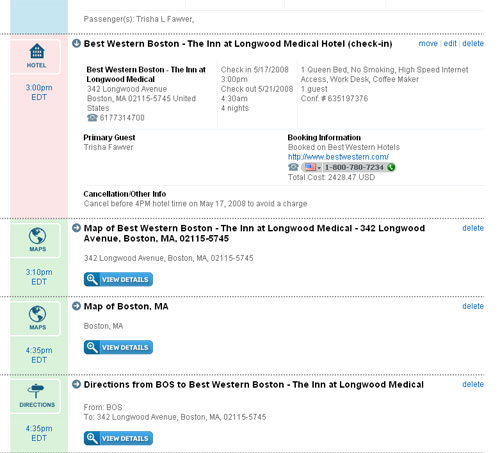
TripIt also integrates well with Google Calendar, which is my online calendar of choice, and adds exact time and details for each appointment, flight, check in, check out, etc. The site has a printable itinerary that is currently keeping me on track here in Boston, and if you’re more of a mobile/smart phone reliant person there’s mobile features as well. I only wish the printable version was color coded as well, but I understand why it’s not.
If you travel a lot for business, you should give this site a try at the least. As all the free toolsday features, it’s FREE! So you have no reason not to go check it out.
Read More


