

Fighting the Advertising Tax in Sacramento
 I wish I could tell you that we had an incredibly productive day in Sacramento, educating numerous state senators personally about affiliate marketing. They all understood what we do and they all agree that adding language to tax bills that make affiliate partners consistute nexus for out-of-state merchants is not going to make the state any money and is a bad idea.
I wish I could tell you that.
Instead, I report back after going to Sacramento last Wednesday, May 12th, with some less-than-uplifting realities about our state government here in California. Late last week, the Performance Marketing Association learned that there was a meeting on the 13th in CA senate subcommittee 5 to discuss adding affiliate nexus language to one of their pending budget bills. It’s not yet back, officially, in the form of a bill in the CA senate or assembly, but just knowing that they’re discussing it is enough for us to try to go educate some lawmakers on what affiliate marketing is, why affiliates shouldn’t create tax nexus for merchants, and why the state won’t actually make the $1.7 million they think they will.
I was asked to join Lisa Picarille and up we went to the capitol, no appointments made due to the last-minute nature of the trip, with high hopes of talking to the three state senators sitting on the subcommittee and laying some education on them. We knew that other affiliates and fighters in this advertising tax battle had previously met with Senator Denise Moreno Ducheny, the chair of the subcommittee and the state Budget and Finance committee, and had not had good luck in getting through to her, so we targeted her office first. She was booked solid in meetings, but we were given a time to check back to see if one of her staff members had a small window of time to talk.
So we went on to the office of Senator Robert Dutton, who we’d heard was on our side. We spoke with a nice staffer in his office who was very well versed on the affiliate nexus issue and assured us that Sen. Dutton opposed the language and that most the Republicans were probably on our side as well. It was very nice to meet with someone who actually knew what we were talking about and understood the issue. In the two previous times I’ve gone to Sacramento, we had uphill battles trying to explain affiliate marketing to blank-faced staffers, so his knowledge about the issue definitely allowed us to cut right to the chase. He suggested some other people we talk to, some influential to the budget committee and subcommittee, and some already on our side that might be able to help in other ways.
Lisa and I then set out for Senator Alex Padilla’s office as it wasn’t yet time to check back in to see if Sen. Ducheny’s staff could talk to us. We were unable to speak to the people Sen. Dutton’s office had recommended, but we spoke to the legislative director who was very interested in learning more and very interactive. He asked us a lot of questions to better understand the issue, and was very interested in the information about Rhode Island not realizing the projected revenue from their version of the advertising tax and their consideration of repeal. Rhode Island actually has a bill in play now, H 7071, set to repeal the “Amazon Tax” but it looks to be stalled and waiting for a proper hearing. So as not to lose time, we quickly had the information emailed to him as we went about to other offices.
 That’s kind of where the magic ended. I have to say, I was feeling okay at that point that people were hearing us out. I didn’t feel that any overly appreciated us being there as private citizens just wanting to spread some education and counter some mis-information being spread by the opposition, but they seemed willing to listen and comprehend. We went to the budget committee office, and they weren’t that helpful. The person we were looking for wasn’t there, and the people who were there told us we were pretty much crazy to attempt to see anyone without an appointment at this time of year. What happened to PUBLIC SERVANTS making themselves available to the PUBLIC, hmm? This served as a harsh reality (to me anyway) that our system is generally broken. We took a break, and after refreshing ourselves with some lunch, we headed back to Sen. Ducheny’s office to check in.
We arrived earlier than the time we were asked to come back, but since we had no one else to see it was worth a shot. We were ushered into the office of a staffer who was, unarguably, the worst attitude and most combative of all the people we talked to that day. She made me very glad I do not live in Sen. Ducheny’s district (40th District). The staffer kept attacking affiliates for working with out-of-state retailers in the first place. I tried to explain to her that, California being just one of 50 states, the “Buy Californian” attitude wasn’t a viable business option, but I got the distinct impression that she didn’t care. She checked her cell phone multiple times while Lisa and I were trying to pleasantly and professional counter her unprofessional combative questions, which is just plain rude no matter what the situation is. She kept asking us what we proposed the state do instead to fix the budget. I wanted to tell her that it’s THEIR job to figure that out, not ours, but instead Lisa suggested some alternatives and tried to focus on the argument that the retailers will just drop CA affiliates, and the state won’t make this money they think they’re going to make.
That being our last meeting of the day, it did leave a bad taste in my mouth about Sacramento and state politics and government in general. I hope I can be of service throughout this fight until we’ve successfully killed the advertising tax, in all forms, here in California. Until then… anyone have a million bucks we can hire a full time lobbyist with? 🙂
Read MoreAffsum Session: NY Tax Laws – Issues & Solutions
Unfortunately I was a bit late to this session today, but I got a lot of good info in the 40 minutes I did attend. The panel consisted of:
- Adam Riemer, Director of Marketing & Client Relations, Downtown Ecommerce Partners (Moderator)
- Chris Henger, Group Product Manager, Google Affiliate Network
- Kim Rodgers, Affiliate Manager, 4Checks.com
- Melanie Seery, Affiliate, NY Affiliate Voice
- Clarke D. Walton, Internet Lawyer, Walton Law Firm, P.C.
First I do have to comment on the panelists – I had the pleasure of hearing a session at ASW08 where Clarke spoke on internet taxes in relation to affiliates and I have to tell you – this is the kind of lawyer you want in your Rolodex. He’s extremely internet and tech savvy, which is always good when you’re talking about internet law. He has experience doing affiliate marketing himself, so he can totally relate to your issues. And he clearly knows his stuff.
Speaking of really knowing their stuff, Kim Rodgers is the ace affiliate manager who really knows what she’s doing, and has built her program up SO much it’s phenomenal. I had the pleasure of sitting with her last night at the Affiliate Dinner (more on that later) and she really is a great AM and has the unique experience of being in the position of a company that initially culled their NY affiliates and now, after some changes internally, are able to welcome them back and have to regain their business (not to mention their trust).
So, the bullet point review of the panel:
- Networks can’t really give any advice to affiliates legally, so they’ve pretty much had to stay out of it.
- Early in July, California explored the NY law and determined that affiliates don’t prove nexus, hence pretty much saying the opposite of what NY is. Hopefully for those of us in California this means that they’ve gotten it out of their heads to try to mimic this.
- Late in July the NY state senate approved a motion to repeal the tax, so while there’s not much news about this yet it’s a step in the right direction in terms of a repeal.
- It’s important for affiliates to be willing to comply and work with their merchants to get through this and maintain a good relationship.
- Affiliates in NY will have to give up a little privacy (like their NY address) in an effort to comply.
- Merchants can simply add a small paragraph into their terms of service that NY based affiliates need to agree to specifically to comply with laws.
- Affiliate managers need to follow up with the NY affiliates to make sure they’ve read the modified TOS and agree.
- Merchants who kicked NY affiliates right away probably have a better chance of wooing them back than merchants who waited until the middle of June and then deactivated the NY affiliates retroactive to May 31st. Melanie’s opinion? “They don’t have a prayer.”
Some take-home answers from the open Q&A:
- The law applies to merchants based in Canada as well (unfortunately I couldn’t hear if they said it applied to international merchants too).
- The law is not clear if nexus is established when a merchant has affiliates who make $10,000 per year aggregate or per affiliate.
- Affiliate managers should not encourage their affiliates to incorporate their businesses in other states. This is a poor work around (it’s not a solution) since, well, what if that state’s next to adopt a similar law? You can’t keep reincorporating and it’s basically fraudulent anyway.
- The state of Washington has come close with a similar law affecting internet sales and taxes. Formerly, the tax rate on an internet sale was calculated based on where the merchant is located. Now, it’s calculated based on where the order is shipping to. This only applies within the state – for now. (As an aside, I know that the California law is already like this and bases tax assessment on the shipping address, being that PsPrint is based in California).
- The federal government is also looking into these laws since we are talking about interstate commerce and may make a move soon, but it’s hard to say in what direction that move will be.
If you caught anything I didn’t (ahem 11|15 Media’s Michael Buechele), please share with the rest of us!
Read MoreCommission Junction Now Listing States
Just noticed this in my CJ account today…they’re now telling us merchants what state the publisher is in.
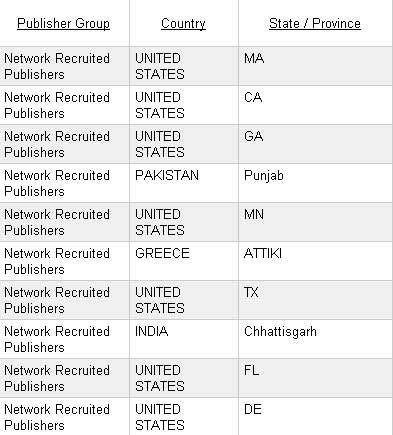
I think this will be beneficial, but also it could be unduly prejudicial with the states looking at similar laws to New York with taxes. Thoughts?
Read More


