

SMX @ ad:tech: Paid Search Fundamentals
 Session Description: Paid search lets you generate traffic from search engines by purchasing ads, usually on a cost-per-click (CPC) or pay-per-click (PPC) basis. This session covers the basics and current best practices of how to purchase placement from the major search engines, including the best ways to succeed with your ads, how to successfully measure performance and how to optimize your complete paid-search marketing strategies. Come join Danny Sullivan and several paid search experts in what promises to be an in-depth review of the paid search marketplace.
This session took place Wednesday, April 22, 2009. The speakers:
- Danny Sullivan, Editor-in-Chief, SearchEngineLand.com (Moderator)
- Mona Elesseily, Director of Marketing Strategy, Page Zero Media
- Chris Zaharias, VP, Search Sales, Omniture
- Nick Sheth, Director of Business Development, Gap Inc. Direct
Unfortunately the presenters talked really quickly, so I tried to get down as much as I could!
Bullet Point Review! Mona Elesseily:
- Get campaign architecture straight from the beginning.
- Think about keywords.
- Tap external sources.
- Proper tracking should be in place from the beginning.
- Is your company equipped to track?
- Define your PPC objectives.
- Tie the objectives to solid metrics.
- Tracking online conversion.
- Online order and pickup offline.
- Store location page.
- PPC local
- Focus on ad copy.
- Brainstorm.
- Product and Service descriptions.
- Calls to action.
- Offers.
- Features/Benefits.
- String things together after brainstorming.
- Brainstorm.
- Think “buying cycle”.
- Testing yields results!
- Get rid of extra information if it doesn’t impact conversions, doesn’t belong.
Nick Sheth:
- Know Your Trademarks.
- Register your marks with Google (including misspellings).
- Ensure you have clear, well communicated policy usage of marks by partners (affiliates, shopping engines, partners, etc.)
- Monitor your marks with a service
- Suggestions: AdGooroo, The Search Monitor, BrandVerity (I can personally vouch that this one is awesome), or Mark Monitor.
- Remember your domains (offensive and defensive).
- Suggestions: Alias Encore (which, again, I can personally vouch for), CitizenHawk.
- Hold domains that are even remotely related.
- Know Your Promotions & Offline Marketing Calendar.
- Calendar your promotions and share them with your agency and all digital marketing teams.
- Leverage offline marketing (buy terms, watch trends, use content ads).
- Finely tune search copy; don’t use blunt force – promotions should be relevant to your ad group.
- Work closely with marketing within your organization on all levels. Building trust is paramount to gaining the autonomy needed to execute quickly.
- Know Your Site.
- Landing page relevancy – right page for right copy and keyword.
- Product availability and assortment – consider using data feeds to automate.
- Dead pages – seems like common sense but there are a lot of ads out there that point to dead pages. Make sure you have internal tools and/or an agency to monitor pages.
- Know More About Your Site.
- Use on-site search to drive SEM & SEO.
- Use paid search to get ideas for SEO.
- Use SEO for paid search keyword ideas.
- Have a human review – don’t leave it all up to automation.
- Know What Works.
- Develop a culture of testing, including landing pages, copy, and promotions.
- Build a test budget into your annual P & L.
- Statistical significance is key.
- Maintain a testing plan that always has tasks and is consistent.
- Know Your Business.
- Understand your goals.
- Understand how you are moving the needle.
- Ensure you’re thinking about your portfolio optimization.
- Question branded search and answer: is it incremental?
- Look at everything holistically.
Chris Zaharias:
- Start -> key business requirements -> keyword research -> campaigns & ad groups -> syndicated strategy -> ad copy -> bid optimization -> analyze & conversions
- Business goals -> KPIs -> Optimization
- Use pre-defined metrics.
- Clicks, Impressions, Click-Through Rate
- Return on ad spend.
- Cost per Acquisition.
- Define and value customer metrics.
- Cart abandonment rate.
- Average Order Value.
- KPIs to measure branding.
- Multi-KPI Optimization.
- Search reacts to TV advertising.
- Measure across channels.
- There’s a myth that the long tail keeps growing – this isn’t true.
- The long tail is now in reverse.
- People are using search as navigation – i.e. they already know what they’re looking for but they go to a search engine to find it easily instead of typing in the URL directly.
- Assumptions:
- The long tail keeps growing.
- There’s 1001 things to do in search.
- PPC = Traffic Management.
- Listen to your search engine.
- Reality:
- Win the head, win the battle.
- Return on efficient, defined work flow.
- Pre & post-click are equally important.
- Search engine advise is often a contrary indicator.
I don’t have any notes from a question period, and I definitely don’t remember there being time for questions. Overall this was a completely useful session for me, given that I’m not an old hat at PPC marketing. It was presented very well and clearly thought out. I appreciated the slide presentations that all three presenters used and I only wish they’d shared them online somehow!
Read MoreAmazon Puts the Kybosh on PPC
All Amazon Associates in North American programs today received an email in which Amazon has notified us of program changes. As of May 1, Amazon will no longer allow associates to drive traffic via pay-per-click ad campaigns.
As of May 1, 2009, Associates will not be paid referral fees for paid search traffic. Also, in connection with this change, as of May 1, 2009, Amazon will no longer make data feeds available to Associates for the purpose of sending users to the Amazon websites in the US or Canada via paid search.
This change applies only to the Associates programs in North America. If you are conducting paid search activities in connection with one of Amazon’s Associates Programs outside of the US and Canada, please refer to the applicable country’s Associates Program Operating Agreement for relevant terms and conditions.
Many programs know that PPC is essential for some affiliates, so it’s interesting that Amazon would chose to alienate these affiliates from their program. I wonder if this is related in any way to the #advertisingtax California AB 178 that we’re working on killing. Only time (or an Amazon insider) will tell!
Read MoreOnline Marketing Glossary: Click Fraud
Click Fraud:
- The deceitful practice of posing as pay-per-click traffic for the purpose of generating false revenue by the affiliates serving the ads. In PPC advertising terms, it generates a charge per click without having actual interest in the target of the ad’s link.
 This, like the click bot, gives black hat affiliates an unfair advantage over the honest affiliates paying for legitimate traffic. The black hat, or unethical, affiliates click on the links repeatedly or from proxies to pose as interested traffic that boosts the click rates that increases how much the affiliates get paid, but in reality these clicks shouldn’t count because they’re not individual web users interested in the product or service being advertised, which is what the merchant is essentially paying for.
____
Glossary Definition From ABC’s of Online Marketing by Alexandra Wharton, Issue 22, Revenue Magazine
Online Marketing Glossary: Pay Per Click
Pay Per Click (PPC):
- A program where an affiliate receives a commission for each click they refer to a merchant’s website. PPC offers some of the lowest commissions and high conversion ratio since visitors need to only click on a link to earn the affiliate a commission.
The most common search engine utilizing PPC is Google AdWords, however some PPC affiliates are also fond of Yahoo and MSN due to the lack of saturation of the market there. The downside is that not as many consumers are using Yahoo or MSN to search than Google. Some of the most successful super affiliates are PPC affiliates.
PPC is the core of search engine marketing (SEM).
____
Glossary Definition From ABC’s of Online Marketing by Alexandra Wharton, Issue 22, Revenue Magazine
Online Marketing Glossary: Landing Page
Landing Page:
- The specific webpage a visitor reaches after clicking on a search engine listing, pay-per-click ad, or banner ad.
Many successful PPC affiliates utilize landing pages to help direct visitors to convert to sales. With a landing page, the affiliate does not have to rely solely on the merchant’s website to convert but can give the visitors a nudge into the conversion path with added details or stronger calls to action.
____
Glossary Definition From ABC’s of Online Marketing by Alexandra Wharton, Issue 22, Revenue Magazine
CJ Jumping into SEO?
I logged into Commission Junction today to see this:
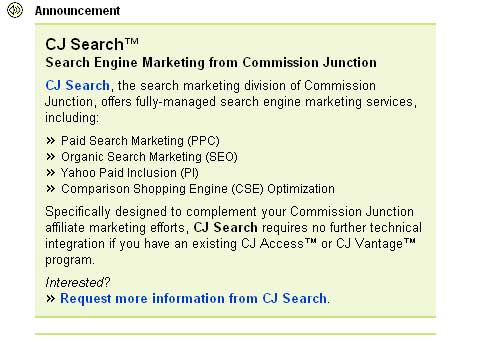
The timing of this is pretty curious, if you ask me. Right on the heels of Google Affiliate Network and their declaring that they’re 86’ing the referrals. So what’s up now Calacanis – SEO still bullshit?
Read More


